The compact motorhome market is changing.
For years, bigger RVs dominated the conversation. More slide-outs, larger living areas, and residential-style features were often considered the definition of a premium motorhome. But as more travelers prioritize easier driving, lower maintenance, and simpler ownership, manufacturers are starting to rethink what a modern RV should be.
The 2027 Winnebago Elora 19DC represents that shift.
At first glance, some of its design choices may look like compromises. There are no slide-outs, no traditional propane system, and instead of a permanent bedroom, it uses a ceiling-mounted power lift bed that disappears when not needed.
But Winnebago’s approach is based on a different idea: instead of adding more features and more weight, why not build a motorhome around the features owners actually use every day?
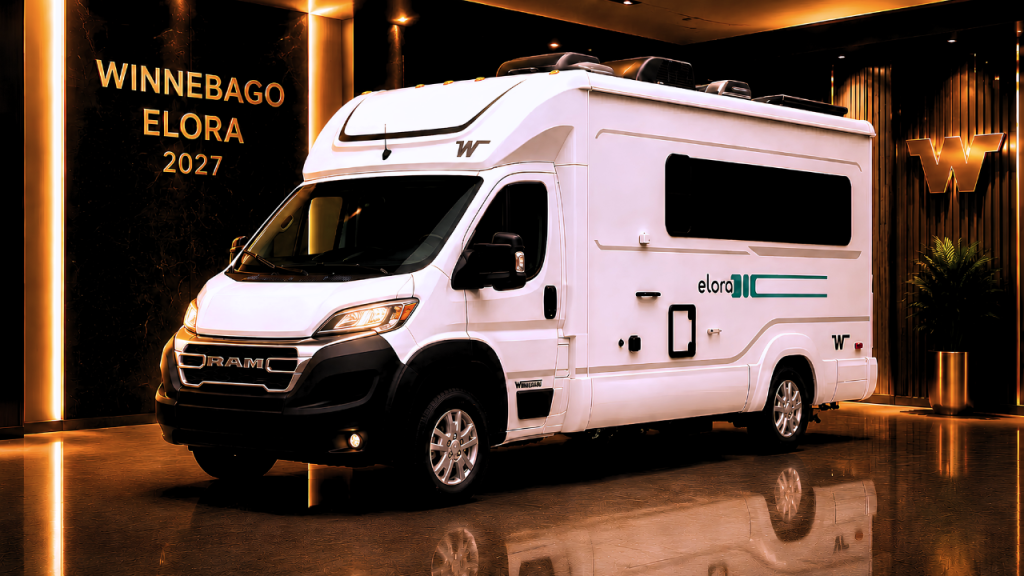
The result is a compact Class C motorhome designed around efficiency, flexibility, and easier ownership. Built on the proven RAM ProMaster platform, the Elora combines automotive-style driving characteristics with a highly optimized interior layout.
The big question is whether this simpler approach creates a smarter RV—or whether buyers will miss the traditional features found in larger Class C motorhomes.
Let’s take a closer look.
Recommended RV Gear
The Elora 19DC already comes with many smart features, but these accessories can make off-grid travel, campsite setup, and everyday RV life even easier.
EcoFlow Portable Power Station: Extra backup power for longer off-grid adventures.
Starlink Mini Kit: Reliable internet connectivity for remote work and travel.
RV Tire Pressure Monitoring System: Monitor tire pressure and temperature for safer highway trips.
RV Surge Protector: Protect your RV’s electrical system at unfamiliar campgrounds.
RV Water Filter: Improve water quality while traveling between different campsites.
RV Leveling Blocks: Quickly stabilize your motorhome on uneven campsites.
Portable Air Compressor: Keep your tires properly inflated wherever the road takes you.
Disclosure: This article contains affiliate links. If you purchase through these links, Auto Insight may earn a commission at no additional cost to you.
Quick Overview
| Specification | Details |
|---|---|
| Class | Compact Class C Motorhome |
| Chassis | RAM ProMaster |
| Engine | 3.6L Pentastar V6 |
| Horsepower | 280 hp |
| Torque | 260 lb-ft |
| Length | 20 ft 4 in |
| Width | 7 ft 6 in |
| Sleeping Capacity | Up to 4 people |
| Seating Capacity | Up to 6 passengers |
| Bed Design | 54" x 75" Power Lift Bed |
| Electrical System | Winnebago Power System with EcoFlow Lithium Hub |
| Storage System | Gear Deck Storage System |
| Starting MSRP | Mid-$150,000 range |
Compact Design Built Around the RAM ProMaster Platform
The foundation of any motorhome determines how it feels to own, and Winnebago made a practical choice by building the Elora on the RAM ProMaster chassis.
Underneath the coach is the familiar 3.6-liter Pentastar V6 engine, producing 280 horsepower and 260 pound-feet of torque. This platform has already proven itself across North America, giving owners the advantage of widespread service availability and easier access to replacement parts.
For RV buyers, that matters more than many realize.
A motorhome is not just a campsite—it is also a vehicle that may travel thousands of miles every year. Choosing a platform with an established automotive support network can make long-distance ownership less stressful compared with less common chassis options.
The Elora also stands out because of its compact dimensions.
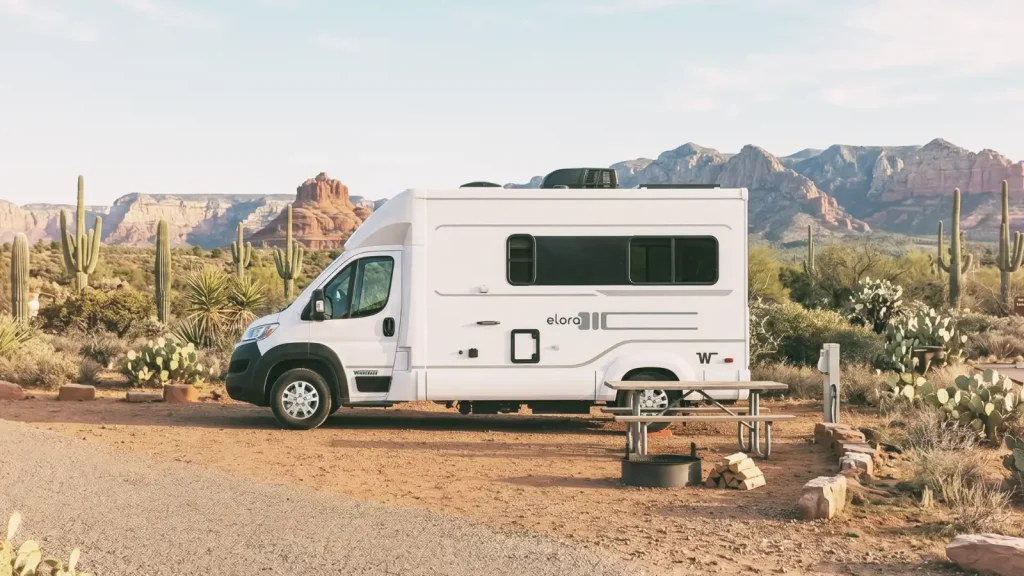
At just 20 feet 4 inches long and approximately 7 feet 6 inches wide, it is significantly smaller than many traditional Class C motorhomes. While larger coaches offer more interior space, they can become challenging when navigating crowded cities, narrow roads, older campgrounds, or tight parking areas.
The smaller footprint changes the entire driving experience.
A shorter body makes the Elora easier to maneuver, easier to park, and less intimidating for drivers who may be moving up from a camper van or smaller travel vehicle. It also allows owners to access campsites that larger motorhomes may struggle to reach.
For travelers who spend more time exploring than staying parked for weeks at a time, this compact design could be one of the Elora’s biggest advantages.
Why No Slide-Outs Could Actually Be a Smart Decision
The most noticeable difference between the Elora and many traditional Class C motorhomes is what Winnebago decided not to include.
There are no slide-outs.
For many RV buyers, slide-outs are almost expected. They create additional living space when parked and can make a smaller motorhome feel much larger. However, they also introduce extra complexity.
Slide mechanisms add weight, moving parts, seals, and potential maintenance issues over time. They can also limit how quickly an RV can be used when stopping for short breaks or overnight stays.
Winnebago took a different approach.
By eliminating slide-outs, the Elora keeps a more straightforward structure while reducing one of the common maintenance concerns found in larger motorhomes.
This design choice also benefits travelers who move frequently.
With a traditional slide-out coach, stopping at a rest area or roadside location often means staying within the main aisle because the expanded living area is not available until the slides are extended. In the Elora, the interior remains functional without any setup process.
That simplicity is especially valuable for RVers who prefer road trips, weekend adventures, or constantly changing locations rather than staying at one campground for extended periods.
However, the trade-off is clear.
A 20-foot motorhome without slide-outs will never provide the same amount of open floor space as a larger Class C with multiple extensions. Buyers who prioritize maximum interior room may still prefer a traditional layout.
The Elora is not trying to replace those larger coaches.
Instead, it focuses on making a compact motorhome easier to drive, easier to maintain, and more practical for everyday travel.
Interior Layout: A Small Motorhome That Maximizes Space
Compact RV design is all about using every inch effectively, and this is where the Winnebago Elora starts to separate itself from many competitors.
Instead of focusing on maximum size, Winnebago designed the interior around multi-purpose spaces.
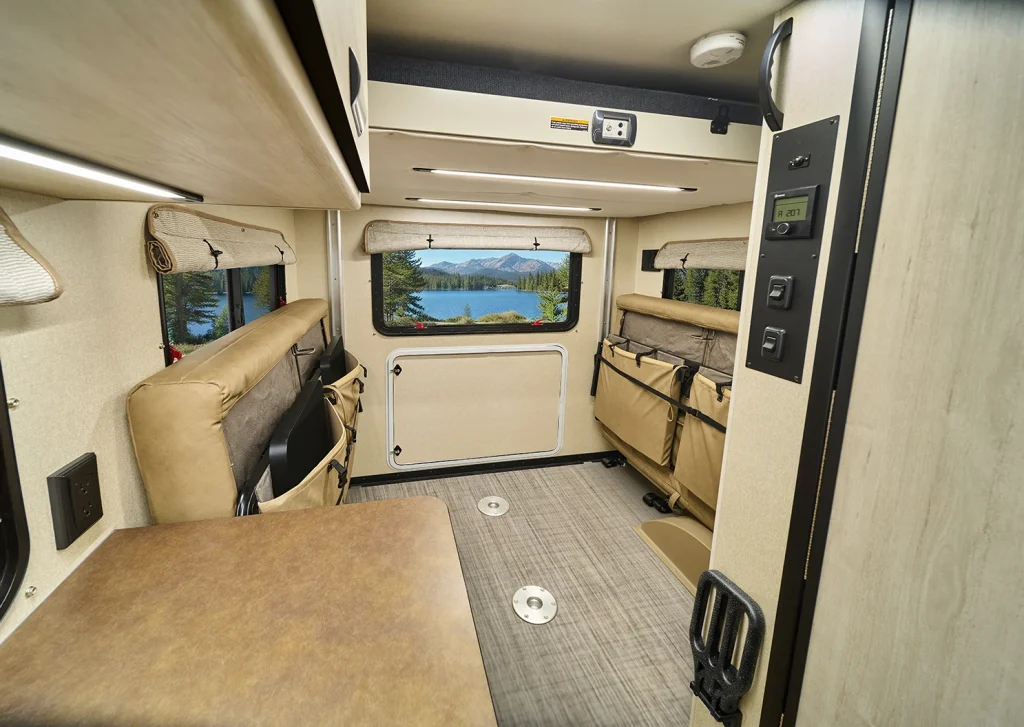
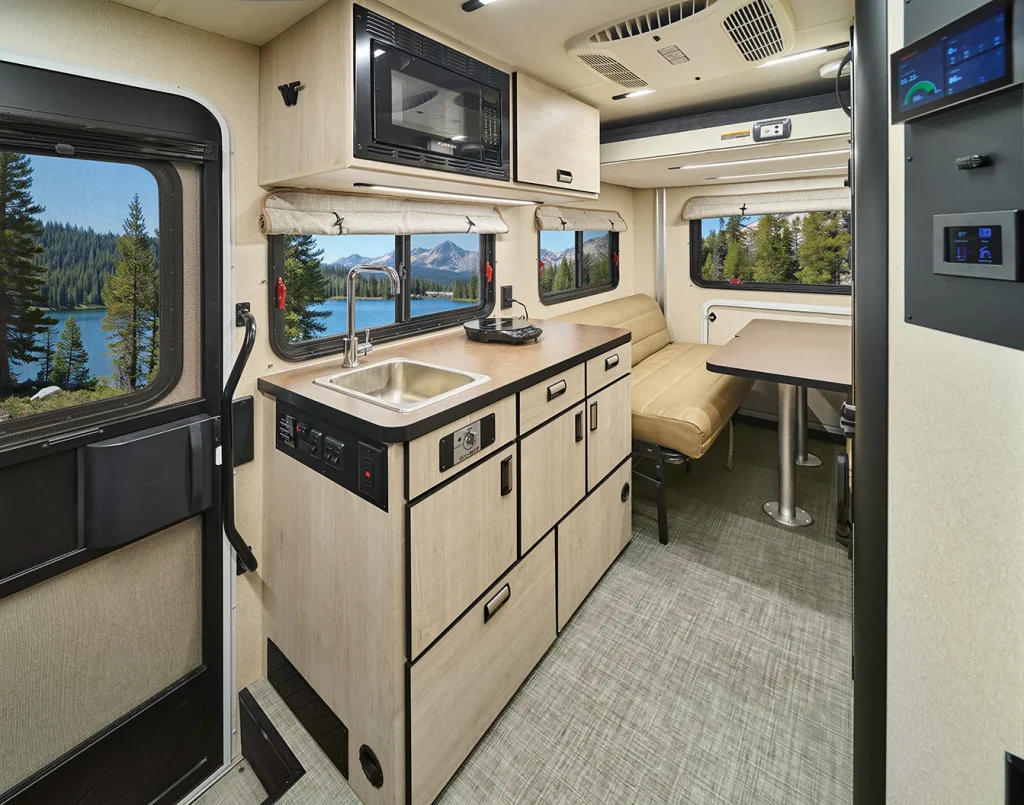
The absence of slide-outs could have made the interior feel restricted, but large side windows and an open center aisle help create a surprisingly spacious atmosphere. The layout feels less like a small vehicle and more like a carefully designed living space.
One of the biggest advantages is flexibility.
The Elora includes DOT-approved seating for up to six passengers, allowing it to function as both a travel vehicle and a comfortable living area. Once parked, that same space transforms into sleeping accommodations for up to four people.
This approach reflects how many modern RV owners actually travel.
Not everyone needs a permanent bedroom taking up half the coach. Many travelers spend their days outside exploring and only need the sleeping area at night. By prioritizing flexible space instead of fixed furniture, Winnebago creates a layout that feels larger than its exterior dimensions suggest.
The centerpiece of this design philosophy is the Elora’s unique power lift bed—but that is where the interior innovation becomes even more interesting.
The Ceiling-Mounted Power Bed Changes Everything
The most innovative feature inside the Winnebago Elora 19DC is arguably the one that disappears when you need it the least.
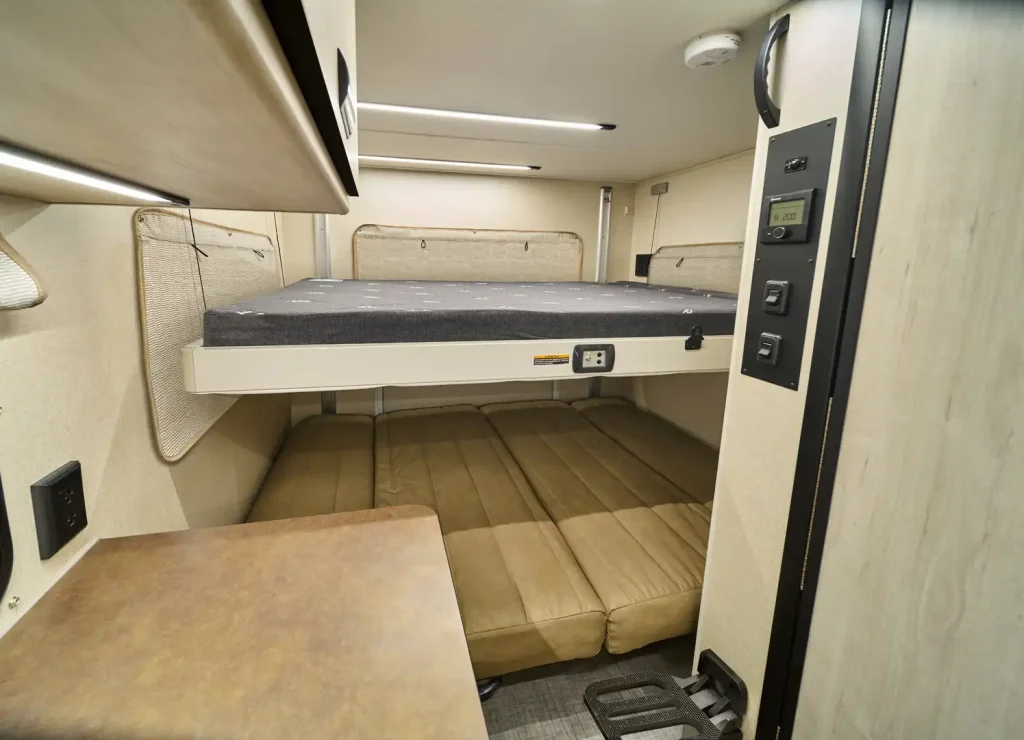
Instead of using a traditional fixed rear bedroom layout, Winnebago installs a 54-by-75-inch ceiling-mounted power lift bed. During the day, the bed remains stored overhead, freeing up valuable floor space for lounging, dining, and daily activities. When it’s time to sleep, the electric system lowers the bed into position.
This simple idea solves one of the biggest challenges in compact motorhomes: limited interior space.
In many small RVs, the bed becomes the dominant feature of the floor plan. A permanent bed may provide convenience, but it also means a large portion of the coach is unavailable for other uses throughout the day.
The Elora takes a different approach.
By moving the sleeping area out of the way when not needed, Winnebago creates two separate experiences inside one compact footprint. During the day, the interior feels like a comfortable lounge area. At night, it transforms into a dedicated sleeping space with a queen-size sleeping area measuring approximately 60 by 80 inches.
This is exactly the type of space efficiency that compact RV design requires.
The power lift bed also highlights Winnebago’s overall philosophy with the Elora. Instead of making the motorhome physically larger, the company focused on making each feature work harder.
For travelers who spend most of their time outside exploring, this approach makes a lot of sense. The RV does not sacrifice precious space for features that are only used for a few hours each day.
However, buyers should consider their personal travel style.
Families who regularly need multiple permanent sleeping areas may prefer a larger Class C motorhome. But couples, solo travelers, or anyone looking for a more flexible layout may find this design far more practical than a traditional floor plan.
Kitchen, Bathroom, and Storage: Smart Use of Every Inch
Compact motorhomes often struggle in three areas: kitchen space, bathroom comfort, and storage capacity.
The Winnebago Elora attempts to solve these challenges through thoughtful design rather than simply adding more size.
A Flexible Kitchen Designed for Daily Use
The kitchen includes the essentials most travelers expect, including:
- 5.3-cubic-foot refrigerator
- Stainless steel sink
- Dedicated storage areas
- Portable induction cooktop
The portable induction cooktop is one of the more interesting choices.
Traditional RV stoves are permanently installed, meaning burners and controls occupy counter space even when they are not being used. In a compact motorhome, every inch of workspace matters.
By making the induction cooktop removable, Winnebago gives owners more flexibility. When cooking is finished, the cooktop can be stored away, creating a larger uninterrupted counter area for food preparation or other daily tasks.
It is a small design decision, but these small improvements often make the biggest difference in a compact RV.
Since the Elora uses an induction cooktop, an induction-compatible cookware set is a smart addition if you’re replacing older pots and pans.
A Complete Wet Bath in a Small Footprint
Another challenge was fitting a full bathroom into a motorhome measuring just over 20 feet.
The Elora includes a complete wet bath with a shower, toilet, and sink. While it does not provide the spacious bathroom experience found in larger Class A or Class C coaches, it delivers something many compact RV buyers value most: independence.
Having an onboard bathroom means owners are not dependent on campground facilities, which is especially important for travelers who enjoy boondocking or staying in remote locations.
Storage That Supports Adventure
Storage is where many compact motorhomes lose practicality.
A beautiful interior means little if there is nowhere to store outdoor equipment, travel gear, and everyday essentials.
Winnebago addresses this with its Gear Deck Storage System and a cargo carrying capacity of up to 2,220 pounds. This provides space for larger items such as:
- Bicycles
- Folding chairs
- Outdoor equipment
- Recovery gear
- Adventure accessories
For active travelers, this is a significant advantage. Many compact RV owners do not just carry clothing and groceries—they bring equipment for the activities they enjoy outside the coach.
Another thoughtful addition is the Starlink-ready cable pass-through. As satellite internet becomes increasingly popular among remote workers and full-time travelers, having a cleaner installation pathway reduces the need for aftermarket modifications.
These details show that Winnebago designed the Elora around how modern RV owners actually use their vehicles.
Modern Power System and Off-Grid Capability
One of the biggest changes in modern RV design is the move away from traditional power systems.
The Winnebago Elora reflects this trend with the company’s Winnebago Power System, centered around a 5-kilowatt-hour EcoFlow lithium power hub.
Instead of depending primarily on a traditional onboard generator, the Elora uses advanced lithium battery technology designed for modern camping needs.
The advantages are significant:
- Faster charging
- More usable energy capacity
- Lower maintenance requirements
- Quieter operation
When combined with available roof-mounted solar, the system allows owners to spend more time away from traditional campgrounds while reducing dependence on generator use.
For RV owners who want additional portable power for camping, tailgating, or emergency backup, the EcoFlow DELTA 3 Portable Power Station is a practical companion that complements modern lithium-powered RVs.
This approach matches the growing popularity of boondocking and off-grid RV travel. Many modern RV buyers are looking for more independence, and efficient electrical systems are becoming just as important as traditional interior features.
Heating and hot water are handled through the Truma Combi G system, which combines both functions into a single integrated unit. This saves space while improving efficiency.
The system also carries Gold Class Cold Weather Certification, giving travelers additional confidence when using the motorhome during colder seasons.
For buyers who want a compact RV capable of supporting modern travel habits, the Elora’s technology package is one of its strongest selling points.

Safety Features and Driving Experience
A major advantage of building on the RAM ProMaster platform is access to modern automotive safety technology.
The Elora benefits from available driver assistance features that were uncommon in RVs just a few years ago, including:
- Adaptive Cruise Control
- Lane Keep Assist
- Traffic Sign Recognition
- Drowsy Driver Detection
- Automatic Emergency Braking
- Digital Rearview Mirror
These systems do not replace attentive driving, but they can reduce fatigue during long highway trips.
For many RV owners, especially those transitioning from smaller vehicles, driving confidence is an important factor. A motorhome that feels familiar and includes modern driver assistance technology can make long-distance travel less stressful.
The Elora’s compact dimensions also contribute to its road manners. Compared with larger Class C models, it is easier to maneuver, simpler to park, and more comfortable in urban environments.
Where the Winnebago Elora 19DC Falls Short
The 2027 Winnebago Elora 19DC is built around efficiency, but every design decision comes with a trade-off.
The biggest limitation is simple: space.
A motorhome measuring just over 20 feet will always have limits compared with a larger Class C coach. Even with clever design, the Elora cannot match the open floor space, storage capacity, or residential feel of a larger motorhome equipped with multiple slide-outs.
For couples or solo travelers, this may not be a major concern. However, families or full-time RVers who spend extended periods inside their coach may eventually want more living space.
The single available floor plan is another consideration.
Many RV buyers enjoy choosing between multiple layouts based on their travel style. Some prefer larger kitchens, dedicated bedrooms, bigger bathrooms, or additional sleeping areas. The Elora keeps things simple by offering one carefully optimized layout, but that means fewer customization options for buyers.
Then there is the price.
With a starting MSRP in the mid-$150,000 range before taxes, destination fees, and additional options, the Elora sits at the premium end of the compact motorhome category.
That pricing means buyers are not necessarily paying for maximum size.
Instead, they are paying for:
- A proven chassis platform
- Smart space utilization
- Modern electrical technology
- Reduced maintenance complexity
- Easier everyday driving
For some buyers, those advantages will justify the price. For others, a larger traditional Class C may offer better value simply because it provides more interior space.
The Elora is not designed to win a size competition.
It is designed for travelers who value efficiency over excess.
🟢 Pros
✅ Compact 20-foot design that’s easier to drive and park
✅ Reliable RAM ProMaster chassis with widespread service availability
✅ Innovative ceiling-mounted power bed maximizes living space
✅ No slide-outs means fewer mechanical components and less maintenance
✅ Modern lithium-based power system with solar capability
✅ Smart kitchen design with portable induction cooktop
✅ Strong storage solution with Gear Deck Storage System
✅ Advanced driver assistance features
✅ Full bathroom despite compact dimensions
🔴 Cons
❌ Limited interior space compared with larger Class C motorhomes
❌ Only one floor plan available
❌ Premium pricing for a compact RV
❌ Not ideal for large families or full-time residential living
❌ Less storage and living area than slide-out coaches
Who Is the 2027 Winnebago Elora 19DC For?
The Elora is designed for a specific type of RV buyer.
It makes the most sense for travelers who want the freedom of a motorhome without the challenges that often come with owning a larger coach.
For someone upgrading from a camper van, the Elora provides a significant improvement in comfort with features like a full bathroom, larger kitchen, more storage, and a dedicated sleeping system.
It is also a strong option for first-time motorhome buyers who may feel overwhelmed by larger Class C models. The compact size makes it easier to drive, while the modern safety technology helps create a more confident ownership experience.
Couples and solo travelers may especially appreciate the design philosophy. Instead of carrying unused space everywhere they go, they get a motorhome that focuses on the features they are most likely to use.
The Elora is also appealing for travelers who frequently move locations.
If your RV lifestyle involves exploring national parks, visiting different destinations, spending time outdoors, and changing campsites regularly, the compact design becomes a major advantage.
However, buyers looking for a full-time residential replacement may want to consider larger alternatives.
If your priority is:
- Maximum interior space
- Multiple permanent sleeping areas
- Large kitchens
- Residential-style living
then a traditional Class C with slide-outs may still be the better choice.
Is the 2027 Winnebago Elora 19DC Worth Buying?
The answer depends on what you value most in an RV.
The Elora is not trying to be the biggest motorhome available. Instead, Winnebago focused on solving the challenges that many RV owners actually experience: difficult driving, complicated maintenance, inefficient layouts, and unnecessary features.
Removing slide-outs may initially seem like a compromise, but for many travelers, it could actually improve ownership. The same applies to the ceiling-mounted bed, lithium power system, and compact footprint.
Every major feature appears to follow the same philosophy:
Make the RV easier to use, easier to maintain, and better suited for modern travel.
Of course, that approach will not appeal to everyone.
A buyer spending more than $150,000 may expect maximum space, and the Elora simply cannot provide the same living area as a larger Class C motorhome.
But for travelers who prioritize mobility, simplicity, and smart engineering, the Elora makes a strong argument.
It is less about having the biggest RV.
It is about having the right RV.
Final Verdict: A Smarter Compact Class C for Modern Travelers
The 2027 Winnebago Elora 19DC represents a different direction for the RV industry.
Instead of adding more size and more complexity, Winnebago focused on thoughtful engineering. The result is a compact Class C motorhome that prioritizes easier driving, flexible living space, modern technology, and lower ownership challenges.
The lack of slide-outs, propane system changes, and permanent bedroom may not appeal to traditional RV buyers. But those choices also create some of the Elora’s biggest strengths.
With its RAM ProMaster foundation, innovative power lift bed, advanced electrical system, practical storage solutions, and compact dimensions, the Elora is clearly designed for the way many people travel today.
It may not replace a large Class C for everyone.
But for couples, solo travelers, weekend explorers, and downsizing RV owners, the 2027 Winnebago Elora 19DC could be one of the most thoughtfully designed compact motorhomes in its class.
For buyers who value practical engineering over unnecessary size, the Elora deserves serious consideration.
Watch the Full Video Review
2027 Winnebago Elora 19DC Review: Smart Design or Too Many Compromises?