
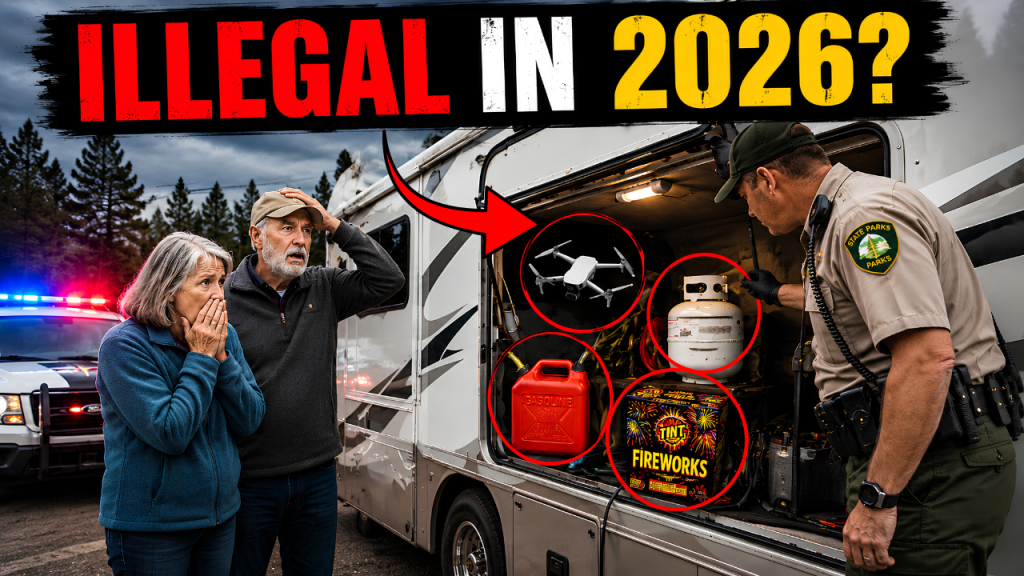
Owning an RV gives you the freedom to explore scenic highways, national parks, and remote campgrounds at your own pace. But with that freedom comes a responsibility many travelers overlook—understanding the laws and regulations that apply wherever you go.
One of the biggest misconceptions among RV owners is that if an item is legal where they live, it’s automatically legal everywhere they travel. Unfortunately, that’s not how it works. State laws, federal regulations, campground policies, and transportation safety requirements can all differ depending on where your journey takes you. That means something as ordinary as a gas can, a bundle of firewood, or even the way you tow your trailer could lead to fines, denied campground entry, or unexpected legal trouble.
The good news? Most of these issues are completely avoidable with a little planning before you hit the road. In this guide, we’ll look at 10 common items and situations that can become illegal or restricted for RV owners in 2026, explain why the rules exist, and share practical tips to help you travel safely, legally, and with confidence.
Quick Overview
| Item | Why It Can Be Illegal or Restricted |
|---|---|
| Improper Fuel Containers | Fire hazards and transportation safety regulations |
| Fireworks | Wildfire risks and campground restrictions |
| Drones | No-fly zones, protected wildlife areas, and federal regulations |
| Firewood | Prevents the spread of invasive insects and tree diseases |
| Old Propane Tanks | Expired or damaged cylinders may not meet safety standards |
| Marijuana on Federal Land | Federal law applies on many public lands regardless of state law |
| Firearms | State laws vary for transportation, permits, and storage |
| Radar Jammers | Illegal or restricted in many jurisdictions |
| Improper Towing Equipment | Must meet local transportation safety requirements |
| Overloaded RVs | Exceeding weight limits creates safety and legal concerns |
Why These Rules Matter More Than Ever in 2026
RV travel continues to grow in popularity, bringing more vehicles onto highways, campgrounds, and public lands than ever before. As a result, many agencies and campground operators are placing greater emphasis on safety, wildfire prevention, environmental protection, and responsible recreation.
While most RV owners never intentionally break the rules, many violations happen simply because travelers aren’t aware that regulations can change when crossing a state line or entering federally managed land.
Spending a few minutes checking the rules before each trip can help you avoid unnecessary fines, equipment problems, and stressful interruptions to your adventure.
10. Improper Fuel Containers
If you enjoy boondocking, off-grid camping, or exploring remote destinations, carrying extra gasoline probably seems like common sense. The problem usually isn’t the fuel itself. It’s the container holding it.
Many RV owners store gasoline in old plastic jugs, water containers, or worn-out fuel cans without realizing they’re creating a serious safety hazard. Unlike approved fuel containers, makeshift containers aren’t designed to safely handle gasoline vapors or pressure changes caused by heat.
Imagine parking your RV in direct sunlight during the middle of summer. As temperatures inside your exterior storage compartment climb, gasoline naturally expands and releases flammable vapors. If the container develops even a tiny leak, those vapors can quickly accumulate inside an enclosed compartment, increasing the risk of fire or explosion.
That’s one reason many campgrounds, ferry operators, tunnels, and transportation authorities require gasoline to be transported only in approved fuel containers that meet current safety standards.
How to Stay Safe
- Use certified gasoline containers designed for fuel storage.
- Store fuel containers upright and securely to prevent spills.
- Replace cracked, leaking, or damaged containers immediately.
- Carry only the amount of gasoline you genuinely need for your trip.
A quality fuel container costs very little compared to the potential damage a fuel-related fire could cause to your RV—or the danger it could pose to you and your family.
 Recommended RV Fuel Container
If you carry extra gasoline on your trips, use a properly designed, approved fuel container rather than an improvised jug.  Check Price on Amazon
9. Fireworks
Nothing says summer camping quite like gathering around the campsite during a holiday weekend. For many travelers, bringing fireworks along feels like part of the celebration. Unfortunately, it’s also one of the quickest ways to get into trouble.
Even if fireworks are perfectly legal where you bought them, they may be prohibited where you’re camping. National parks, many state parks, private campgrounds, and public recreation areas often ban fireworks because of the significant wildfire risk they create.
During dry conditions, a single spark can ignite nearby grass, leaves, or brush, putting campers, wildlife, and surrounding forests at risk. Besides potential fines, violating campground rules could also result in being asked to leave the property without a refund.
Before You Pack Fireworks
Ask yourself these questions before loading them into your RV:
- Does the campground allow fireworks?
- Are there local or state restrictions where I’m traveling?
- Are fire conditions or burn bans currently in effect?
If you want to enjoy fireworks during your trip, attending an organized public display is usually the safest—and often the only legal—option.
8. Flying a Drone Where It's Prohibited
Drones have become one of the most popular travel accessories for RV owners. They capture breathtaking aerial views of lakes, mountains, forests, and scenic campgrounds that simply aren’t possible from the ground. But just because a location is beautiful doesn’t mean it’s legal to fly there. Many national parks, protected recreation areas, wildlife refuges, and other public lands either restrict or completely prohibit recreational drone use.
Temporary flight restrictions, emergency closures, and wildlife protection measures can also affect where you’re allowed to fly. Ignoring those rules could lead to warnings, fines, confiscation of equipment, or other penalties. The last thing anyone wants is to end an unforgettable camping trip by explaining an unauthorized drone flight to a park ranger.
Fly Responsibly
Before launching your drone:
- Verify local drone regulations.
- Check for temporary flight restrictions.
- Register your drone if required.
- Respect protected wildlife areas and designated no-fly zones.
- Be considerate of other campers by avoiding low or noisy flights over campsites.
Taking just a few minutes to check the rules before every flight can save you significant trouble—and help preserve the peaceful outdoor experience everyone came to enjoy.
7. Transporting Firewood Across State Lines
A bundle of firewood might seem like one of the most harmless things you can pack for an RV trip. But in some cases, it can also be one of the most problematic. Many RV travelers load leftover firewood from a previous camping trip or cut wood at home before hitting the road. It seems like an easy way to save money, but transporting untreated firewood can unintentionally spread invasive insects and destructive tree diseases into healthy forests.
Pests such as the emerald ash borer and other wood-boring insects often hide beneath the bark, making them nearly impossible to spot. Once introduced into a new area, they can damage thousands of trees and create long-term environmental problems.
To help slow the spread of these invasive species, many national parks, state parks, forests, and campgrounds discourage—or outright prohibit—bringing outside firewood onto their property. Some states also restrict transporting untreated firewood across state lines or through quarantine zones. You might arrive at your favorite campground only to discover that your carefully packed firewood has to be left behind before you can even check in.
Burn It Where You Buy It
The easiest way to stay compliant is to follow one simple rule:
- Buy firewood near your destination.
- Burn all of it before leaving.
- Never transport leftover firewood to your next campsite.
- Check campground rules before your trip.
Besides helping you avoid potential fines or confiscation, purchasing firewood locally supports nearby businesses and helps protect America’s forests for future campers.
6. Propane Tanks That No Longer Meet Safety Requirements
Propane is one of the most important utilities inside an RV. It powers your stove, refrigerator, furnace, water heater, and other essential appliances that make camping comfortable year-round. But like any piece of safety equipment, propane tanks don’t last forever. Over time, cylinders can develop rust, corrosion, damaged valves, worn fittings, or reach inspection and requalification deadlines that prevent refill stations from legally refilling them.
Imagine arriving at a campground late on a chilly evening. You stop to refill your propane tank, only to be told that the cylinder no longer meets current safety requirements. Without propane, you could lose heat, hot water, refrigeration, and cooking capabilities—all because of a problem that could have been discovered before leaving home. Even if an older tank still appears to work perfectly, visible damage or expired certification markings may be enough for a refill station to refuse service.
Propane Safety Checklist
Before every travel season:
- Inspect the tank for rust, dents, or corrosion.
- Check valves and fittings for visible damage.
- Look for leaks before every trip.
- Verify inspection or requalification dates.
- Replace damaged cylinders instead of attempting temporary repairs.
A quick inspection only takes a few minutes, but it can prevent costly delays, protect your RV, and help keep everyone traveling with you safe.
🛒 RV Propane Safety Essential
Before your next trip, make sure your propane equipment is in good condition and suitable for safe RV use. 👉 Check Price on Amazon
5. Marijuana on Federal Land
Cannabis laws have changed significantly across the United States over the past several years, creating understandable confusion for many RV travelers. A product that is perfectly legal to purchase in one state may become illegal the moment you enter certain public lands. This is where many travelers get caught off guard.
National parks, many federally managed recreation areas, and other federal properties operate under federal law rather than state law. That means marijuana possession may still be prohibited, even if recreational or medical cannabis is legal in the surrounding state. For example, you could legally purchase cannabis in one city, drive only a short distance, enter a national park, and suddenly be subject to an entirely different set of regulations. Many RV owners simply assume the same rules continue to apply throughout their trip, but that’s not always the case.
Before Entering Federal Land
If your travel plans include any federally managed property, take a few minutes to understand the regulations before you arrive.
This commonly includes:
- National parks
- National forests
- Federal recreation areas
- Wildlife refuges
- Other federally managed public lands
Crossing a campground entrance or park boundary may not seem like a major change, but legally, it often is. Understanding where state law ends and federal regulations begin can help you avoid unnecessary legal complications and enjoy your trip with greater peace of mind.
4. Firearms Across State Lines
Many RV owners choose to travel with a firearm for personal protection, especially when camping in remote areas or boondocking far from populated towns. Owning a firearm legally, however, doesn’t automatically mean you can transport it the same way everywhere you travel.
Firearm laws vary significantly from one state to another. A concealed carry permit that’s recognized in one state may not be valid in the next. Storage requirements, magazine capacity limits, transportation rules, and notification requirements for law enforcement can all change as you cross state lines.
For RV travelers who visit multiple states on a single trip, it’s surprisingly easy to violate a law without realizing it. Imagine driving through three or four states on your way to a national park. Even if you never remove the firearm from your RV, the rules governing how it must be stored or transported could be completely different in each jurisdiction. A routine traffic stop is the last place you want to discover those differences.
Before Crossing State Lines
Take a few minutes to research the laws for every state on your route.
Pay special attention to:
- Whether your permit is recognized.
- Transportation requirements.
- Safe storage regulations.
- Magazine capacity restrictions.
- Duty-to-inform laws, where applicable.
- Rules for firearms on public lands and campgrounds.
Spending a little time planning before your trip can help you avoid serious legal complications and allow you to travel with greater confidence.
3. Radar Jammers
Nobody enjoys getting a speeding ticket. That’s why many drivers look for electronic devices that promise to help them avoid one. But not all of those devices are treated the same under the law. One of the biggest misconceptions involves the difference between radar detectors and radar or laser jammers. While radar detectors are legal in many places for private passenger vehicles, radar and laser jammers are often prohibited or heavily restricted depending on the technology involved and where you’re traveling.
Many products advertised online blur the distinction, leading buyers to believe they’re purchasing a legal driving aid when they’re actually buying equipment that may violate local regulations. Installing one without understanding the law could result in citations, equipment confiscation, or additional legal problems during a traffic stop.
Before Buying Any Driving Device
Ask yourself a few simple questions:
- What exactly does the device do?
- Is it detecting signals or actively interfering with them?
- Is it legal in every state you’ll be traveling through?
- Does your route include jurisdictions with additional restrictions?
Doing your homework before making a purchase is far easier—and much less expensive—than dealing with the consequences afterward.
2. Illegal Towing Setups
Just because your RV is capable of towing another vehicle or trailer doesn’t automatically mean the setup is legal. Towing regulations vary from state to state, and many RV owners don’t realize their equipment may need to meet additional safety requirements once they cross a state line. Depending on the size and weight of what you’re towing, local laws may require supplemental braking systems, properly functioning tail lights, correctly rated safety chains, breakaway systems, or other safety equipment.
Skipping one of these components might not seem like a big deal—until you’re stopped during a roadside inspection or involved in an accident. Even something as simple as a disconnected lighting cable or worn safety chain could result in a citation or prevent you from continuing your trip until the problem is corrected. The larger your RV and the heavier your towed vehicle, the more important these safety systems become.
Inspect Your Towing Setup Before Every Trip
Before heading out, make it a habit to check:
- Brake systems
- Electrical connections
- Tail lights and turn signals
- Safety chains
- Hitch components
- Breakaway cable
- Tire condition
- Hitch weight ratings
A thorough inspection takes only a few minutes, but it can help prevent expensive repairs, improve road safety, and reduce the risk of legal issues while traveling.
🛒 Recommended Towing Safety Gear
A quick inspection of your towing equipment can help prevent problems before you hit the highway. 👉 See Recommended Towing Gear
1. Overloaded RVs (Exceeding Weight Limits)
Of all the mistakes RV owners make, this is probably the most common—and one of the most dangerous. It’s surprisingly easy to overload an RV without realizing it.
- Camping chairs.
- Generators.
- Portable grills.
- Extra batteries.
- Toolboxes.
- Bicycles.
- Full water tanks.
- Outdoor furniture.
- Food.
- Clothing.
Before long, hundreds—or even thousands—of extra pounds have been added to the vehicle. Every RV is built with specific weight limits established by the manufacturer, including its Gross Vehicle Weight Rating (GVWR) and individual axle weight ratings.
These limits aren’t just recommendations. They’re designed to ensure your RV can brake, steer, and handle safely under normal driving conditions. When those limits are exceeded, the additional weight places extra stress on nearly every major component of your RV, including:
- Tires
- Suspension
- Brakes
- Axles
- Wheel bearings
- Frame
- Steering components
An overloaded RV may require a much longer distance to stop, become harder to control during emergency maneuvers, and increase the likelihood of tire failures or mechanical breakdowns. Even if your RV seems to drive normally, excess weight can accelerate wear on expensive components and increase liability if you’re involved in an accident. The challenge is that many RV owners don’t know they’re overweight until they visit a certified public scale.
How to Check Your RV’s Weight
Before every major trip:
- Load your RV exactly as you plan to travel.
- Fill water and fuel tanks as needed.
- Visit a certified public scale.
- Compare your actual weight to the manufacturer’s ratings.
- Check individual axle weights whenever possible.
- Remove unnecessary cargo.
- Distribute heavy items evenly throughout the RV.
Knowing your RV’s actual weight is one of the simplest—and most effective—steps you can take to improve safety, protect your investment, and avoid unnecessary legal or mechanical problems on the road.
RV Safety Essentials Worth Having
A few simple safety essentials can make RV travel easier and help you avoid common problems on the road. Here are some practical items worth considering before your next trip.
| Product | Short Description | Price |
|---|---|---|
| RV Tire Pressure Monitoring System | Monitor tire pressure and temperature. | Check Price on Amazon |
| RV Surge Protector | Protect your RV from electrical issues. | Check Price on Amazon |
| RV Propane Leak Detector | Detect potential propane leaks. | Check Price on Amazon |
| RV Fire Extinguisher | Essential protection against RV fires. | Check Price on Amazon |
| RV Towing Safety Kit | Essential gear for safer towing. | Check Price on Amazon |
Affiliate Disclosure: We may earn a commission if you purchase through links on this page, at no additional cost to you
Frequently Asked Questions About RV Travel Laws in 2026
The rules surrounding RV travel can be confusing because they often depend on where you’re traveling rather than what you’re carrying. Here are answers to some of the most common questions RV owners ask before hitting the road.
Are these items illegal in every state?
No.
Most of the items on this list aren’t illegal everywhere. In many cases, the restrictions depend on state laws, local ordinances, campground rules, or whether you’re traveling on federally managed land. For example, fireworks may be legal in one county but prohibited in the next, while a firearm permit recognized in one state may not be valid after crossing the border into another. That’s why it’s always a good idea to review the regulations for every state and campground on your route before you travel.
Can a campground refuse entry because of prohibited items?
Yes.
Many private campgrounds, state parks, and public recreation areas have their own rules that visitors must follow. Depending on the campground, you may be asked to remove or properly store items such as:
- Fireworks
- Outside firewood
- Improper fuel containers
- Drones
- Certain pets or hazardous materials
Violating campground policies could result in denied entry or being asked to leave without a refund.
Is it legal to carry gasoline inside an RV?
Yes—but only if it’s transported safely.
Gasoline should always be stored in approved fuel containers that are designed for flammable liquids. Damaged, leaking, or improvised containers can create serious fire hazards and may violate campground or transportation safety rules. Only carry the amount of fuel you actually need, and always store containers upright in a secure location.
Can I fly my drone anywhere while camping?
No.
Many public lands restrict or prohibit recreational drone flights. Before flying, always check:
- Local drone regulations
- Campground policies
- Temporary flight restrictions
- Protected wildlife areas
- Posted signs at your destination
Just because an area is scenic doesn’t automatically mean drone flights are permitted.
Is marijuana legal in an RV if it’s legal in the state I’m visiting?
Not necessarily.
If your trip includes federally managed land, federal regulations may still apply regardless of state law. Always understand which laws govern the area you’re visiting before bringing cannabis products into your RV.
How do I know if my RV is overloaded?
The only reliable way is to weigh it.
Load your RV exactly as you plan to travel—including passengers, food, water, fuel, camping gear, and any accessories—then visit a certified public scale. Compare the results with your RV’s Gross Vehicle Weight Rating (GVWR) and axle weight ratings. Many owners are surprised to learn they’re carrying significantly more weight than expected.
Final Thoughts
Owning an RV is all about freedom—the freedom to explore new places, discover hidden campgrounds, and create unforgettable memories on the open road. But that freedom comes with an important responsibility: understanding the rules that apply wherever your journey takes you.
As you’ve seen, most of the items on this list aren’t illegal simply because you own them. The real issue usually comes down to where you’re traveling, how the item is transported, or whether it complies with current safety regulations. A few minutes of preparation before each trip can save you from expensive fines, denied campground entry, damaged equipment, or unexpected legal headaches.
Before you leave home, take time to:
- Review the laws for every state on your route.
- Check campground rules before you arrive.
- Inspect your RV and safety equipment.
- Verify your towing setup and vehicle weight.
- Replace worn or outdated equipment before it becomes a problem.
These simple habits not only help you stay compliant—they also make every trip safer and more enjoyable for everyone traveling with you. After all, the goal isn’t to travel with less gear. It’s to travel smarter.
What’s Your Experience?
Have you ever arrived at a campground and discovered a rule you weren’t expecting? Maybe you were asked to leave firewood behind, denied a propane refill, or surprised by a local towing regulation. Share your experience in the comments below. Your story could help another RVer avoid the same mistake and make their next adventure a little smoother. And if you found this guide helpful, consider sharing it with a fellow RV owner. A quick share today could save someone from a costly mistake tomorrow.
Safe travels, and happy camping!
🎥 Watch: 10 RV Items That Could Get You Fined in 2026
Before you hit the road, make sure you know what you can legally carry in your RV. This video breaks down 10 common items and situations that could lead to fines, denied campground entry, or unexpected trouble in 2026.